

How to Remove Water Spots from Boat Glass and Windshields Without Scratching
Aug 18th 2026
Water spots, salt residue and cloudy mineral buildup can make an otherwise clean boat look neglected. They commonly appear on boat windshields, cabin windows, side glass, stainless steel, chrome, fiberglass and other surfaces repeatedly exposed to water.
The challenge is that not every clear boat surface is made from standard glass.
Some boat windshields are glass, while others may be made from plexiglass, acrylic, polycarbonate, Lexan, isinglass or clear vinyl. A cleaning method that works safely on standard glass may scratch, haze or permanently damage a softer clear material.
Before trying to remove water spots from boat glass or marine windows, the first step is identifying the surface.
Koenig Polish is a multi-surface cleaner, polish, restorer and protector designed to help remove surface buildup, improve shine and leave behind a slick protective finish. When used properly on a compatible surface, it can help reduce water spots, salt film, grime and mineral residue while making future cleaning easier.
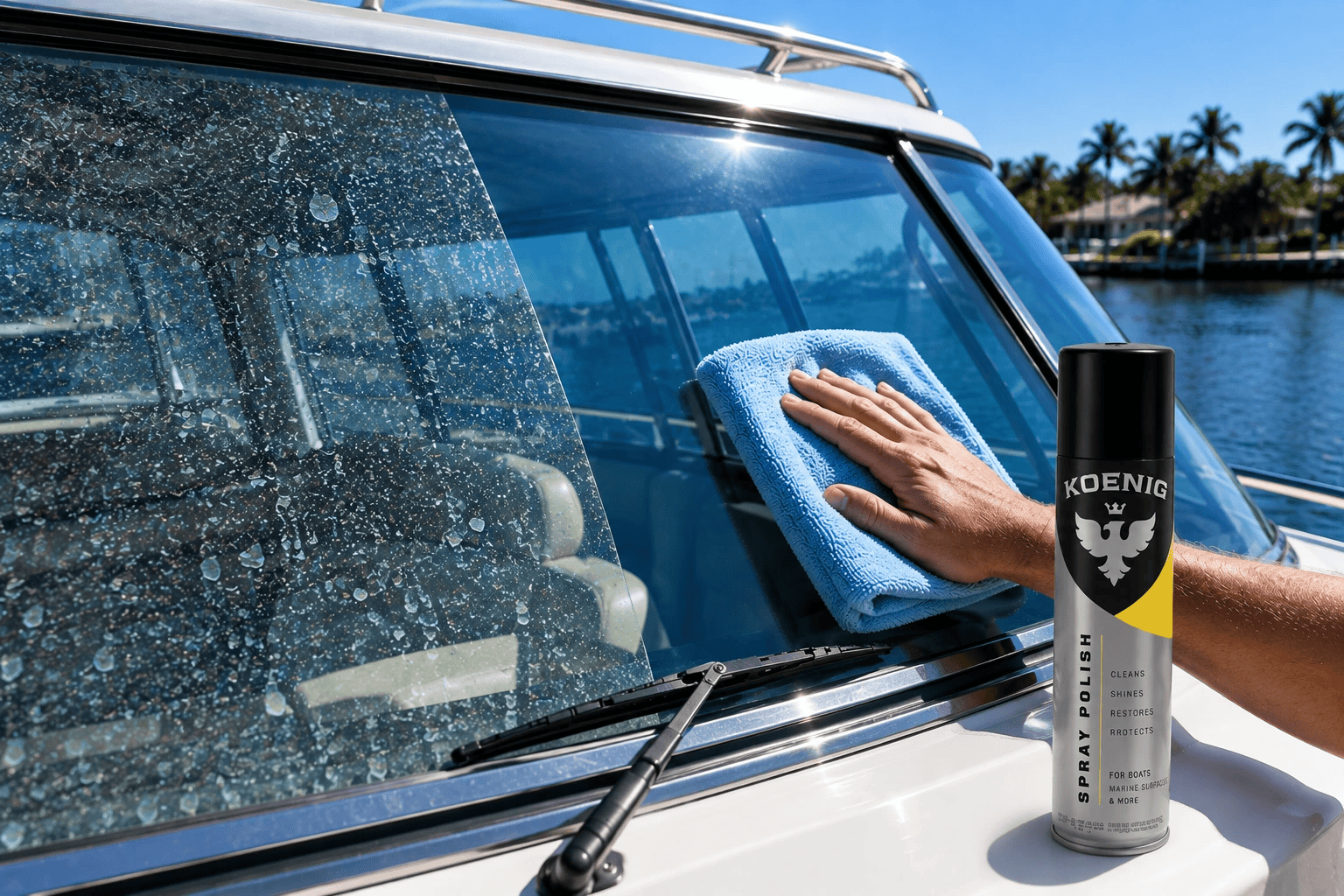
Why Water Spots Form on Boat Glass
Water spots form when water evaporates and leaves dissolved minerals or salt behind.
Depending on where and how a boat is used, the remaining residue may include:
- Calcium
- Magnesium
- Salt
- Mineral scale
- Soap residue
- Marina water contamination
- Sprinkler residue
- Washing-water minerals
- Environmental grime
The longer this residue remains on the surface, the more difficult it may become to remove.
Water spots commonly appear after:
- Washing with hard water
- Allowing rinse water to air-dry
- Saltwater spray drying on the surface
- Rain followed by strong sunlight
- Marina sprinklers hitting the boat
- Repeated exposure without protective maintenance
- Leaving the boat uncovered outdoors
- Failing to dry the windshield after cleaning
Fresh surface spots are usually easier to remove than deposits that have remained on the boat for months or years.
Salt Residue vs. Hard-Water Mineral Deposits
Salt residue and hard-water mineral deposits can look similar, but they are not always the same problem.
Salt residue often appears as a white, cloudy or gritty film after salt spray dries on the boat.
Hard-water spots are usually created by calcium, magnesium and other minerals remaining after freshwater evaporates.
A boat windshield may have both at the same time.
Loose salt residue may come off during a thorough rinse and cleaning. Mineral deposits may require additional polishing action because they can bond more strongly to the surface.
Before using a polish, rinse away loose dirt, sand and salt crystals. Rubbing those particles across the surface can create scratches, particularly on plexiglass, acrylic, polycarbonate, isinglass and clear vinyl.
Identify the Boat Window Material Before Cleaning
Do not assume every boat windshield is standard glass.
Clear marine surfaces may include:
- Tempered glass
- Laminated glass
- Plexiglass
- Acrylic
- Polycarbonate
- Lexan
- Isinglass
- Clear vinyl
- Coated or tinted transparent panels
The safest cleaning method depends on the material.
Standard glass is generally harder and more resistant to scratching than acrylic or clear vinyl. Plexiglass, acrylic, polycarbonate, Lexan, isinglass and clear vinyl can scratch, haze or distort more easily.
Check the boat manufacturer’s documentation or ask the dealership, marina or window manufacturer when the material is uncertain.
Always test Koenig Polish on a small, inconspicuous area before treating the entire windshield or window.
How to Remove Water Spots from Standard Boat Glass
The following process may be used on compatible standard boat glass after confirming the material and reviewing the manufacturer’s instructions.
Step 1: Work on a Cool Surface
Move the boat into shade when possible.
Avoid working on glass that is extremely hot from direct sunlight. Heat can cause cleaning products to dry too quickly and make even application more difficult.
Step 2: Rinse Away Loose Salt and Dirt
Use clean water to remove:
- Loose salt
- Sand
- Dirt
- Dust
- Surface grit
- Marina contamination
Do not begin polishing while abrasive particles remain on the glass.
Step 3: Dry the Surface
Use a clean, soft microfiber towel.
Inspect the glass after drying to determine whether the remaining marks are surface water spots, mineral deposits or possible permanent etching.
Step 4: Apply Koenig Polish
Shake and use the product according to its label instructions.
Apply a controlled amount to the surface or an appropriate clean microfiber towel.
Work in a small section rather than attempting the entire windshield at once.
Step 5: Work the Product Into the Water Spots
Use gentle to moderate pressure on confirmed standard glass.
Allow the cleaning and polishing action to work on the mineral residue.
Do not use steel wool, aggressive pads or abrasive tools unless the surface has been confirmed as uncoated standard glass and the glass or boat manufacturer specifically approves the method.
Never use steel wool on plexiglass, acrylic, polycarbonate, Lexan, isinglass or clear vinyl.
Step 6: Buff the Surface Clear
Use a separate clean microfiber towel to remove residue and buff the glass.
Inspect the area from several angles and in different lighting.
Step 7: Repeat When Necessary
Stubborn surface deposits may require another controlled application.
Long-neglected mineral buildup may require more effort than recent water spots.
If repeated proper application does not improve the area, the mark may be permanent etching rather than removable surface residue.
How to Clean Plexiglass and Acrylic Boat Windows Safely
Plexiglass and acrylic require more caution than standard glass.
These materials can scratch from:
- Coarse towels
- Dry wiping
- Sand or salt crystals
- Aggressive scrubbing
- Abrasive pads
- Steel wool
- Dirty polishing towels
- Incompatible solvents
- Excessive machine polishing
Before using any cleaner or polish:
- Confirm the exact material.
- Review the manufacturer’s care instructions.
- Rinse away loose contamination.
- Use only clean, soft microfiber towels.
- Test a small area first.
- Use light pressure.
- Stop immediately if hazing or distortion appears.
Koenig Polish may be evaluated as part of a careful surface-maintenance routine when it is compatible with the specific material. It should not be represented as automatically safe for every type of plexiglass, acrylic, polycarbonate or coated marine window.
Do not use steel wool or aggressive abrasives on these materials.
How to Clean Isinglass and Clear Vinyl
Isinglass and clear vinyl boat enclosures are softer than standard glass and require gentle care.
Before cleaning:
- Rinse away salt and grit
- Use cool or lukewarm water
- Avoid harsh solvents
- Avoid stiff brushes
- Avoid paper towels
- Avoid dry wiping
- Avoid aggressive rubbing
- Follow the enclosure manufacturer’s instructions
Use a clean microfiber towel and test a small area before treating an entire panel.
Clear vinyl can develop scratches, cloudiness, yellowing or distortion that cannot always be corrected with a surface cleaner.
Koenig Polish should only be used after confirming compatibility with the particular clear-vinyl material and manufacturer guidance.
Water Spots or Permanent Etching: How to Tell the Difference
Not every cloudy mark on boat glass is removable.
Surface mineral deposits sit on top of the glass and may improve during cleaning and polishing.
Etching occurs when minerals, chemicals or prolonged environmental exposure physically alter the surface.
Possible signs of surface deposits include:
- Roughness that can be felt
- White or cloudy spotting
- Improvement after polishing a test area
- Uneven mineral film
- Spots that change when wet
Possible signs of etching include:
- The surface feels smooth but still looks damaged
- No meaningful improvement after proper cleaning
- Spots appear embedded in the glass
- Permanent rings or cloudy areas remain
- Optical distortion is visible
- The damage has been present for a long time
Permanent etching may require professional glass polishing or replacement.
Koenig Polish can help remove surface buildup and improve appearance, but it should not be represented as repairing every permanently etched or physically damaged window.
How Koenig Polish Helps Clean, Restore and Protect Boat Surfaces
Koenig Polish is designed to provide four primary benefits:
- Clean.
- Shine.
- Restore.
- Protect.
On compatible boat surfaces, Koenig Polish can help with:
- Water spots
- Salt residue
- Mineral buildup
- Surface grime
- Fingerprints
- Light haze
- Stainless steel
- Chrome
- Fiberglass
- Gelcoat
- Painted surfaces
- Compatible glass and clear materials
The product also leaves behind a slick, water-repellent protective finish.
This hydrophobic surface helps water bead and roll away more easily. It can also reduce how strongly future water spots, salt residue, grime and environmental contamination adhere to the treated surface.
The protection does not eliminate the need for cleaning, but it can make regular maintenance faster and easier.
How to Help Prevent Water Spots from Returning
Removing water spots is only part of the solution.
The following practices can help reduce future buildup.
Rinse After Saltwater Exposure
Do not allow salt spray to remain on glass and clear marine surfaces longer than necessary.
Dry the Glass After Washing
Allowing mineral-heavy rinse water to air-dry creates new water spots.
Use a clean microfiber drying towel.
Avoid Washing in Direct Sunlight
Sunlight and heat can cause water to evaporate before the surface is properly dried.
Maintain the Protective Finish
Reapply Koenig Polish as needed according to the product directions, surface condition and environmental exposure.
Keep Towels Clean
A towel containing sand, salt or dried residue can scratch the surface.
Use the Correct Product for the Material
Do not treat plexiglass, acrylic, isinglass or clear vinyl like standard glass.
Address Spots Early
Recent surface deposits are usually easier to remove than mineral buildup left on the boat for months.
Best Uses for Boat Owners, Marinas and Detailers
Koenig Polish may be useful for:
- Boat owners cleaning their own windshields
- Marinas maintaining customer boats
- Boat detailers removing water spots
- Boat dealerships preparing boats for display
- Yacht-maintenance companies
- Marine service departments
- Boat-rental fleets
- Marine supply stores
- Businesses recommending boat-care products
Because Koenig Polish is a multi-surface product, the same can may also help maintain compatible fiberglass, gelcoat, stainless steel, chrome, painted surfaces and other marine areas.
That can reduce the need to carry a separate product for every routine surface-care task.
Professional users should still evaluate compatibility, surface condition and manufacturer guidance before implementing the product across an entire fleet or customer-service process.
Frequently Asked Questions
What is the best way to remove water spots from boat glass?
Begin by identifying the glass material, rinsing away loose salt and grit, and drying the surface with a clean microfiber towel. Koenig Polish can then be applied to compatible standard glass in small sections to help remove surface water spots, improve clarity and leave a protective finish. Always test a small area first.
Can Koenig Polish remove hard-water stains from boat windshields?
Koenig Polish can help remove surface hard-water spots, mineral deposits and cloudy residue from compatible boat windshields. Long-neglected deposits may require repeated application. Permanent etching may require professional glass restoration.
Can Koenig Polish be used on boat plexiglass?
Plexiglass, acrylic, polycarbonate and Lexan require special care. Confirm the material, follow the manufacturer’s instructions and test a small inconspicuous area first. Never use steel wool or aggressive abrasives on these materials.
Can steel wool be used on a boat windshield?
Steel wool should never be used on plexiglass, acrylic, polycarbonate, Lexan, isinglass or clear vinyl. Even on standard glass, it should only be considered after confirming that the glass is uncoated and the boat or glass manufacturer approves the method.
How do I remove salt residue from a boat windshield?
Rinse the windshield thoroughly with clean water before wiping. This removes loose salt crystals that might scratch the surface. After drying, Koenig Polish may help remove remaining film and buildup from compatible surfaces while leaving a slick protective finish.
Why does my boat glass still look cloudy after cleaning?
The cloudiness may be caused by bonded mineral deposits, salt film, chemical damage, surface scratching or permanent etching. Test a small area with an appropriate cleaning and polishing method. If the area does not improve, professional restoration may be needed.
Does Koenig Polish help prevent future water spots?
Koenig Polish leaves a slick, water-repellent protective finish that helps reduce how strongly water, minerals, salt residue and grime adhere to compatible surfaces. Regular rinsing and drying are still necessary.
Can marinas and boat detailers use Koenig Polish?
Yes. Marinas, boat detailers, dealerships and yacht-maintenance companies may evaluate Koenig Polish for compatible boat glass, fiberglass, gelcoat, stainless steel, chrome and painted surfaces. Professional users should test the product on each material and follow manufacturer guidance.
Remove Water Spots and Make Future Boat Cleaning Easier
Koenig Polish helps clean, shine, restore and protect compatible boat surfaces, including water-spotted glass, fiberglass, gelcoat, stainless steel, chrome and painted surfaces.
Its slick, hydrophobic finish helps reduce how strongly water, salt residue and grime adhere to treated surfaces, making future maintenance easier.
Learn More About Marine Surface Care
Are you a marina, boat detailer, marine supply store, dealership or yacht-maintenance company?
Contact Koenig Polish for professional-use, case-pricing and dealer opportunities.