

Best Aircraft Cleaner and Polish: What to Look for When Detailing an Airplane
Sep 8th 2026
Choosing an Aircraft Cleaner Is About More Than Shine
Ask ten aircraft owners or detailers what the “best” aircraft cleaner is and you may get ten different answers. That is not necessarily because one person is right and the others are wrong. Aircraft vary by paint system, age, operating environment, materials, contamination and maintenance practices. A product that works well for routine exterior care on one aircraft may not be the right answer for a different surface or a more severe restoration problem.
The better question is: what should you evaluate before choosing an aircraft cleaner, polish or protectant? A useful product should fit the surface, the contamination, the required level of correction and the operator’s maintenance requirements. It should also make sense in the real workflow of the person who has to use it.
For professional detailers, that last point matters. A product can perform well in a demonstration and still be a poor fit if it adds unnecessary steps, creates uncertainty around material compatibility or requires a complicated process that crews will not follow consistently.
1. Start With Surface Compatibility
Aircraft exteriors can include painted aluminum, polished metal, composites, decals, specialty coatings, de-ice components and transparent materials. Those surfaces should not automatically be treated as if they were all the same. Before using any cleaner or polish, identify the surface and review any applicable aircraft, coating or component-manufacturer instructions.
For routine painted exterior surfaces, a small test area is a practical first step whenever a product is unfamiliar. The test should show more than whether the surface looks shiny. Check for residue, streaking, unexpected softening, discoloration or any change in appearance after the product is removed.
Professional detailers should build this into their normal process. Surface identification and test-spot discipline reduce risk and also make product comparisons more meaningful.
2. Match the Product to the Contamination
Aircraft accumulate several very different types of contamination. Bug residue on a leading edge behaves differently from oily belly grime. Exhaust staining is different from mineral spotting, and light surface oxidation is different from ordinary dirt. Trying to solve every condition with the most aggressive chemical available is rarely a good process.
For a closer look at how these contamination types show up on an airframe and where a multi-function product fits into cleaning them, our guide to aircraft polish for bugs, exhaust stains and plexiglass windows walks through the details.
For routine exterior maintenance, the ideal first approach is usually the least aggressive method that does the job. Remove loose grit, work in small areas and escalate only when the condition actually requires it. A product that can handle common light contamination while also improving gloss or leaving protection may reduce steps, but severe contamination may still need a dedicated process.
This is why the “best aircraft cleaner” is not simply the one with the strongest cleaning claim. It is the one that fits the work being performed without creating unnecessary surface risk.
3. Understand the Difference Between Cleaning, Polishing and Restoration
Cleaning removes contamination. Polishing improves the surface appearance by addressing light defects, oxidation or dullness. Restoration can involve a much more involved process, including machine polishing or other corrective steps. Those terms should not be treated as interchangeable.
On a well-maintained aircraft, cleaning and light polishing may be all that is required. On a neglected surface, a hand-applied product may improve appearance but not fully correct deep oxidation, failing paint or severe defects. A credible maintenance plan begins by diagnosing the condition honestly.
This distinction also prevents unrealistic expectations. If a surface is physically deteriorated, no cleaner should be marketed as a substitute for proper paint correction, repair or refinishing.
4. Consider Protection and Future Maintenance
The job is not finished when the surface looks good at the end of the day. Protective maintenance can make later cleaning easier by reducing how strongly ordinary contamination bonds to the surface. That matters on aircraft because bugs, exhaust residue, environmental fallout and water spotting are recurring problems.
When comparing products, ask what kind of maintenance interval is realistic for the aircraft’s environment and use. Hangared aircraft, ramp-stored aircraft, high-utilization trainers and privately flown aircraft will not all behave the same way. Protection should be evaluated as part of a maintenance system rather than as a universal calendar promise.
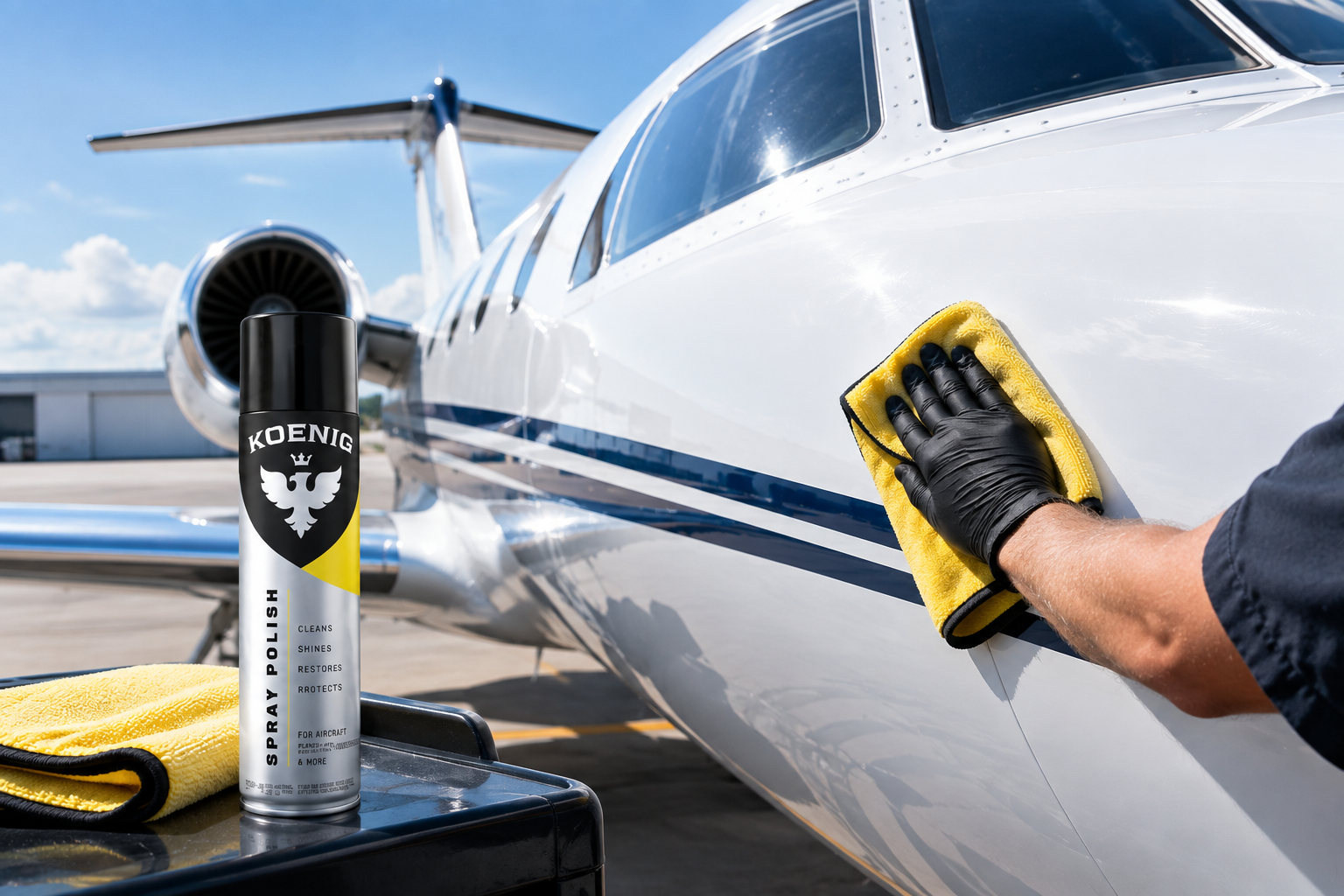
Koenig Polish is designed to clean, shine, restore and protect appropriate surfaces in one application. In suitable conditions it can provide durable hydrophobic and protective performance, but actual durability depends on the surface, preparation, exposure and use.
5. Evaluate Workflow, Not Just Product Performance
Professional aircraft detailers often use multiple chemicals because each one has a defined job. That can be appropriate. It can also create unnecessary complexity if several products overlap heavily. Product consolidation is useful only when it reduces steps without sacrificing results or safety.
A practical comparison should therefore measure more than gloss. Track application time, amount of product used, number of towels or pads required, ease of residue removal, rework, surface behavior and the quality of the final finish. If a product performs multiple light-maintenance functions well, it may simplify part of the process even if it does not replace every specialty chemical in the shop.
This is the right way to evaluate Koenig Polish as well. The goal is not to tell an experienced detailer that the products already in the cabinet are wrong. The goal is to determine where Koenig can add value alongside the current system and whether repeated use naturally reduces the need for overlapping products.
6. Technical Documentation Matters in Aviation
In automotive detailing, a shop may be free to test a new product and adopt it quickly. Aviation can involve additional layers: company policy, maintenance control, insurers, fleet standards or customer requirements. A professional product conversation should respect those approval gates rather than talk around them.
Koenig Polish has independent technical support for this process. SMI independently tested Koenig to Boeing BSS7432 and it conformed to the listed tests in that evaluation. That is an accurate statement. It should not be converted into “Boeing approved,” “Boeing certified” or “FAA approved.”
If a customer or insurer requires documentation, the useful next step is to ask exactly what they need. That may include the SDS, the SMI BSS7432 conformance page, product information or other company-specific material. Treating the approval process professionally is more credible than making a broad certification claim. For questions about product use, documentation or suitability, contact Koenig Polish for additional information.
7. A Simple Way to Compare Aircraft Detailing Products
When evaluating a new aircraft cleaner or polish, use a controlled test instead of relying on memory. Choose a representative area, document the starting condition, follow the product directions and compare the result with the current process. If possible, evaluate again after normal use to see how the surface behaves during the next cleaning.
For a professional detailer, useful questions include: Did it reduce time? Did it improve gloss? Did the residue wipe off cleanly? Did the next wash become easier? Did it work on more than one appropriate exterior surface? Did it create any material-compatibility concern? Would the technician choose to use it again?
A product earns a place in a professional system through repeatable results, not through a single dramatic before-and-after photo.
Where Koenig Polish Fits
Koenig Polish has been used for surface care for more than two decades across multiple markets, including aviation. It is carried by aviation retailers including Aircraft Spruce and Sporty’s, and the product is demonstrated directly to aircraft owners and detailers at major aviation events.
For aircraft exterior care, Koenig can be evaluated as a multi-function cleaner, polish and protectant on appropriate surfaces. The most useful way to test it is not to assume it must replace an entire existing detailing system on day one. Use it on a suitable application, compare the result, and determine where it fits based on performance.
If the aircraft, coating, component or operator has a specific approved-maintenance requirement, follow that requirement. A good product evaluation works inside the aircraft’s maintenance framework, not outside it.
Frequently Asked Questions
What is the best way to clean and polish an airplane?
Start by identifying the surface and the type of contamination. Remove loose grit, use a compatible cleaning process, work in small sections and use the least aggressive method that achieves the result. Light polishing can improve dullness or mild oxidation, while severe defects may require machine correction or professional refinishing.
Can the same polish be used on aircraft and cars?
Some multi-surface products may be appropriate for both, but aircraft can include materials and maintenance requirements that differ from automobiles. Do not assume compatibility. Check the specific aircraft surface and follow manufacturer or operator instructions.
Does an aircraft cleaner have to be Boeing approved?
There is no reason to describe a product as “Boeing approved” unless Boeing has actually provided that approval. Koenig Polish was independently tested by SMI to Boeing BSS7432 and conformed to the listed tests in that evaluation. That is the appropriate technical description.
How often should an aircraft exterior be protected?
There is no single interval for every aircraft. Exposure, storage, flight hours, washing frequency, climate and surface condition all matter. Inspect the surface and maintain protection based on actual use rather than a universal schedule.
Should a professional detailer replace all current chemicals with one product?
Not necessarily. Specialty contamination and sensitive materials can require dedicated products. A better strategy is to test where a multi-function product can reduce overlapping steps without compromising performance or surface requirements.
Learn more about Koenig Polish for aircraft cleaning, polishing and protective maintenance at the Koenig aircraft page. You can also shop Koenig Polish products for available cleaning and polishing solutions.